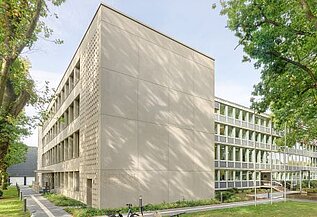
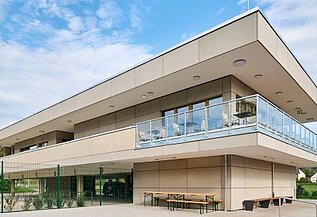
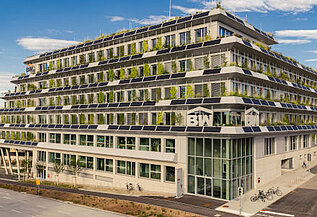
Life cycle assessment: betoShell® combines concrete and sustainability
Sustainable planning and building are significant contributors to how our living spaces are going to be structured in the future. The beginning of the 1990s already saw HERING prioritising sustainability in the development of its new products. The company cooperates closely with such renowned German universities as RWTH Aachen and TU Dresden in its work on new products and concepts. The result is the development of betoShell® textile-reinforced concrete for use in the field of architectural concrete.

betoShell® Textile-Reinforced Concrete – Transparent Environmental Data
Thanks to its thin panels, the betoShell® façade system allows for reduced concrete consumption. Depending on the project and façade construction, concrete consumption per square metre of façade area can be reduced by up to 80% compared with a comparable conventional reinforced concrete façade.
Differences between façade systems can also be seen in their greenhouse gas emissions. In the comparison shown, betoShell® FLEX30 has up to 75% lower global warming potential (GWP) than a natural stone façade across life cycle stages A1–A3 (raw material supply, transport and manufacturing). The actual environmental impact depends on the systems compared, the underlying assumptions and the specific project conditions (see chart).


Certificates
Environmental Product Declaration (EPD)
In 2025, HERING published the first verified life cycle assessment for its betoShell®FLEX 30 product on its website and in the ÖKOBAUDAT database.
Concrete Sustainability Council (CSC)
In recognition of decades of research into solutions for producing resource-efficient concrete, HERING Bau GmbH & Co. KG Systeme was awarded CSC Gold certification for the first time in February 2026, achieving an outstanding score of 75.39%.