

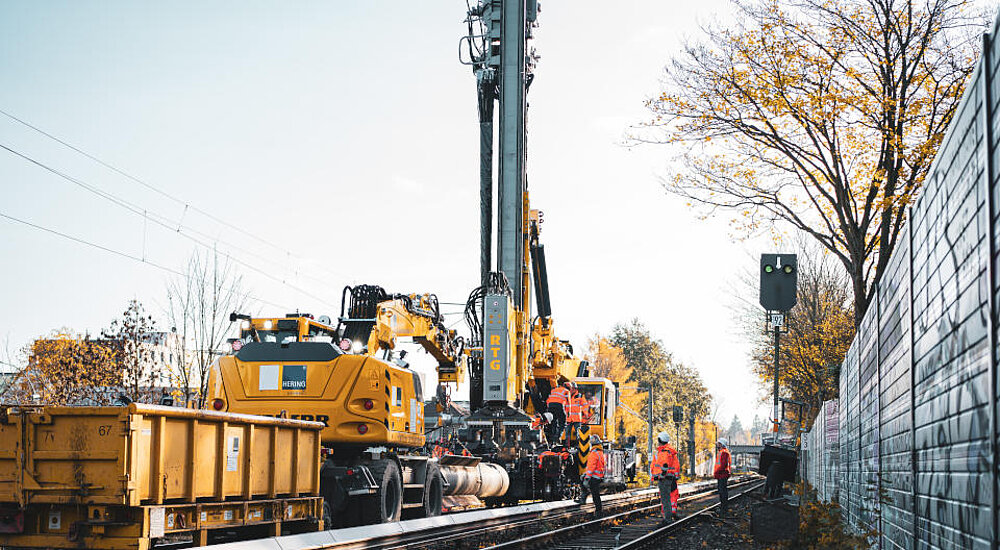
A pile was driven in as the foundation for a signal bracket during the construction of the new S4 S-Bahn (suburban) railway link (Hamburg – Bad Oldesloe). The foundation was located on an embankment between the tracks of the S1 S-Bahn rail link and the mainline railway – it was therefore not possible to access it from the outside – but that was a situation for which the track-foundation-laying train was literally designed for.
The track-foundation-laying train allowed the workers to complete the foundation for a signal bracket in an inaccessible location within less than 40 hours – and without the need to dismantle any railway infrastructure. A total success!

2.00 a.m.: The shoring work began at the foundation point once the construction track had been installed. The track-foundation-laying train was prepared at a nearby suburban railway siding at the same time. The foundation pipe (DN 813) was attached to the hydraulic vibrator and vibrated 6.5 metres into the ground along with the welded-on side plates once the track-foundation-laying train had been positioned at the foundation point. The track-foundation-laying train was then converted on site to the Kelly drilling method for the purposes of boring out the foundation pipe down to the base.
The foundation pile was concreted with the reinforcement cage having been lifted into place that same evening.
The reinforcement work for the head foundation with the integrated anchor rods as a connection for the signal bracket to be fitted later was commenced the next morning.
The prefabricated concrete element was placed over the lost formwork, the anchor rods were aligned for the final time and the head foundation was concreted at around midday.



At HERING, we see ourselves as pioneers in the field of sustainability. As early as 1996, we were the first construction company in Germany to obtain EMAS certification. Every three years, we publish an environmental statement documenting our goals and how we have achieved them. Actually, for the first time, we published a sustainability report with an integrated environmental statement in accordance with EMAS - a logical next step in view of our ecological and social responsibility. It documents how we deal internally and externally with the issues that are essential to our future viability.


