
Menü
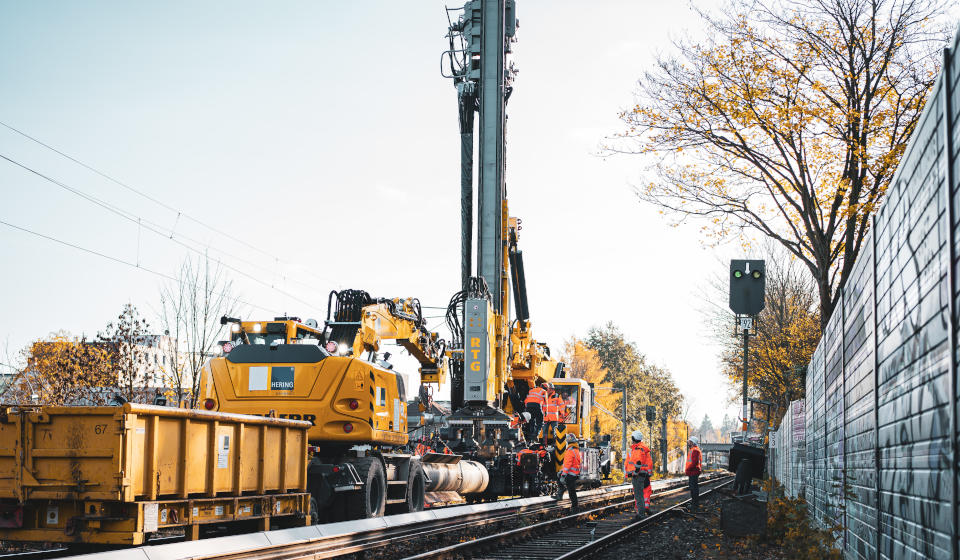
Foundation Construction Train
Track Foundations with HERING

Foundation Construction Train

New and special civil-engineering technology for railway construction

Highest track availability and short shut-down times, challenging geographies and confined spaces demand know-how, experience and high-performance as well as approved special civil-engineering technology for railway construction. 

The global market leader in railway cranes, Kirow Ardelt, together with RTG Rammtechnik (a specialist in vibration, piling, and pressing works from the BAUER Maschinen Group), has developed the high-performance track foundation train for HERING and the rail market. With its special rigging procedures, tool logistics, high foundation performance, quality, and speed, this rail-mounted carrier adapts special foundation engineering methods to railway applications. It ensures the safe, cost-effective, and project-specific implementation of your requirements.

Track foundations with equipment by HERING

  • Vibration-free drilling of holes with diameters of up to 1350 mm
  • MR 105 V (SilentVibro) vibrator for the high-frequency vibrating of sheet-piling profiles of lengths of up to 15 metres
  • HRS 5 hydraulic hammer for pile driving lengths of up to 12,20 metres
  • MPU 660 sheet-piling press or MPZ for pressing sheet pilings, Z-profiles, U-profiles and light profiles of up to 15 metres in length
Vorschaubild YouTube Video
Foundation Construction Train: The Revolution!

FIELDS OF APPLICATION – WITHOUT CONSTRUCTION ROAD

  • Realisation of bored piles using the Kelly drilling method for overhead line masts, signal brackets, noise barriers, etc.
  • Vibrating / pressing of sheet piling for securing excavations and stabilising railway embankments as well as installing girders for Berlin shoring, etc.
  • Driving in of concrete piling and casing pipes using the HRS5 hydraulic hammer
  • Installation of vibro-replacement stone columns for ground improvements in or near tracks (VIPAC method)
     

PERSPECTIVELY:

  • Production of bored piles using the rigid-cast-in-place method
  • Boring of cased and overlapping piles for bridge foundations and overlapping bored pile walls (front-of-wall method)
  • Realisation of single columns / diaphragm walls using the cutter-soil-mixing (CSM) and CSM DH methods as ground-improvement measures
  • Down-the-hole (DTH) hammer for drilling in rock


Foundation Construction Train - details:

  • Rail-mounted carrier equipment
  • Leader for use with special civil-engineering tools (vibrator, sheet-piling press, hydraulic hammer, kelly drilling equipment, etc.)
  • Comprehensive system consisting of a carrier unit, flat-bed carriage for storing the leader and additional flat-bed carriage for transporting and setting up attachments
  • Extends up to 9,50 metres from the track axis
  • Use in superelevations of up to 160 mm
  • Hydraulic rams for support distances of up to four metres from the track axis
  • 360° swivelling around the upper carriage axis
  • Operation that keeps the opposite track free: maximum protrusion of upper carriage from the track axis is 1.55 metres
  • High foundation-laying performances, quality and speed

Heavy duty machinery and Foundation Construction Train: News

HERING Bahnbau successfully completes railway overpass project in Porta Westfalica

Within a 126-hour track possession from 28 February to 6 March 2025, the Structural Engineering division successfully completed a key infrastructure project in Porta Westfalica-Wittenhusen. The objective: to enhance operational safety and performance by replacing outdated structures and constructing essential new components.

The bridge and track works were carried out with utmost precision and tightly coordinated workflows – all geared towards achieving maximum progress in the shortest possible time.

Lifting Operation for the Railway Bridge

Watch on YouTube

Construction timeline

The project began with the removal of 400 metres of existing track. Rails, sleepers, and all other track components were fully dismantled and professionally disposed of. Simultaneously, two temporary bridges, each measuring 19.20 metres in length, were dismantled. Preparatory works for the installation of the new bridge structures were then carried out on the substructure.

A central element of the project was the installation of two new steel superstructures to replace the existing bridge system. These were lifted and positioned with precision using tandem crane operations, meeting all structural and static requirements. Following this, transition structures were installed to ensure a seamless and secure connection between the new bridge components and the railway line. These transitions were meticulously aligned with the existing track geometry.

To guarantee long-term stability and optimal load distribution, the bearings and transition structures were subsequently grouted to specification. As construction progressed, the HGT base layer was installed, followed by the placement of under ballast mats. These contribute to improved track bed damping, reduce vibrations, and help extend the service life of the track superstructure.

Following the completion of foundation and substructure works, a new 400-metre section of track was constructed. New rails and sleepers were laid, aligned, and fixed in accordance with all technical specifications.

To ensure continuous track geometry, the track was machine-tamped and adjusted to its final position. A subsequent stress neutralisation process was carried out, followed by a total of eight thermite welds to establish durable and load-resistant rail joints.

On the home stretch

All construction activities were executed in compliance with the highest safety and quality standards. The trades involved worked in close coordination, enabling the project to be completed on schedule and the track section to be returned to operation as planned.

The entire project was documented on film. Over the past weeks, five time-lapse videos of the construction phases were published on our YouTube channel – and now, the full video compilation is available online.

For more information, please visit our digital project board for the Railway bridge Wittenhusen.

Tamping machine in action during track lifting

Exhibitions / Events

HERING Bahnbau successfully completes railway overpass project in Porta Westfalica

Within a 126-hour track possession from 28 February to 6 March 2025, the Structural Engineering division successfully completed a key infrastructure project in Porta Westfalica-Wittenhusen. The objective: to enhance operational safety and performance by replacing outdated structures and constructing essential new components.

The bridge and track works were carried out with utmost precision and tightly coordinated workflows – all geared towards achieving maximum progress in the shortest possible time.

Lifting Operation for the Railway Bridge

Watch on YouTube

Construction timeline

The project began with the removal of 400 metres of existing track. Rails, sleepers, and all other track components were fully dismantled and professionally disposed of. Simultaneously, two temporary bridges, each measuring 19.20 metres in length, were dismantled. Preparatory works for the installation of the new bridge structures were then carried out on the substructure.

A central element of the project was the installation of two new steel superstructures to replace the existing bridge system. These were lifted and positioned with precision using tandem crane operations, meeting all structural and static requirements. Following this, transition structures were installed to ensure a seamless and secure connection between the new bridge components and the railway line. These transitions were meticulously aligned with the existing track geometry.

To guarantee long-term stability and optimal load distribution, the bearings and transition structures were subsequently grouted to specification. As construction progressed, the HGT base layer was installed, followed by the placement of under ballast mats. These contribute to improved track bed damping, reduce vibrations, and help extend the service life of the track superstructure.

Following the completion of foundation and substructure works, a new 400-metre section of track was constructed. New rails and sleepers were laid, aligned, and fixed in accordance with all technical specifications.

To ensure continuous track geometry, the track was machine-tamped and adjusted to its final position. A subsequent stress neutralisation process was carried out, followed by a total of eight thermite welds to establish durable and load-resistant rail joints.

On the home stretch

All construction activities were executed in compliance with the highest safety and quality standards. The trades involved worked in close coordination, enabling the project to be completed on schedule and the track section to be returned to operation as planned.

The entire project was documented on film. Over the past weeks, five time-lapse videos of the construction phases were published on our YouTube channel – and now, the full video compilation is available online.

For more information, please visit our digital project board for the Railway bridge Wittenhusen.

Tamping machine in action during track lifting
Icon Social Media Auswahl