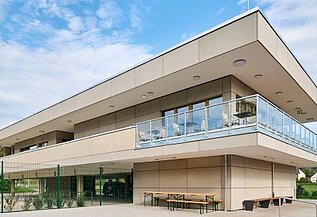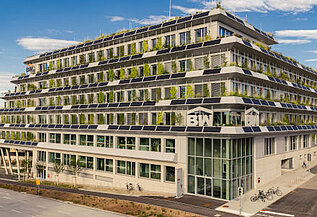
Sustainable planning and building are significant contributors to how our living spaces are going to be structured in the future. The beginning of the 1990s already saw HERING prioritising sustainability in the development of its new products. The company cooperates closely with such renowned German universities as RWTH Aachen and TU Dresden in its work on new products and concepts. The result is the development of betoShell® textile-reinforced concrete for use in the field of architectural concrete.

betoShell®FLEX30 is verified
betoShell®FLEX30 is known for its slender design, high durability, and creative freedom – and for certified environmental performance. Our façade system has been awarded an official Environmental Product Declaration (EPD), confirming its sustainability and transparency across the entire life cycle.
An EPD is a standardized, independently verified document that presents the environmental impact of a product across all life cycle stages – from raw material extraction and production, through use, to deconstruction and recycling. The EPD for betoShell®FLEX30 complies with DIN EN 15804 and ISO 14025, and has been verified by an independent third party.
✔ Transparency: Fact-based, traceable documentation of all environmental impacts
✔ Credibility: Independently verified and standardized environmental data
✔ Sustainability: Long-lasting, resource-efficient façade technology
Thanks to its thin panels, the betoShell® façade system allows for reduced concrete consumption. Depending on the project and façade construction, concrete consumption per square metre of façade area can be reduced by up to 80% compared with a comparable conventional reinforced concrete façade.
Differences between façade systems can also be seen in their greenhouse gas emissions. In the comparison shown, betoShell® FLEX30 has up to 75% lower global warming potential (GWP) than a natural stone façade across life cycle stages A1–A3 (raw material supply, transport and manufacturing). The actual environmental impact depends on the systems compared, the underlying assumptions and the specific project conditions (see chart).