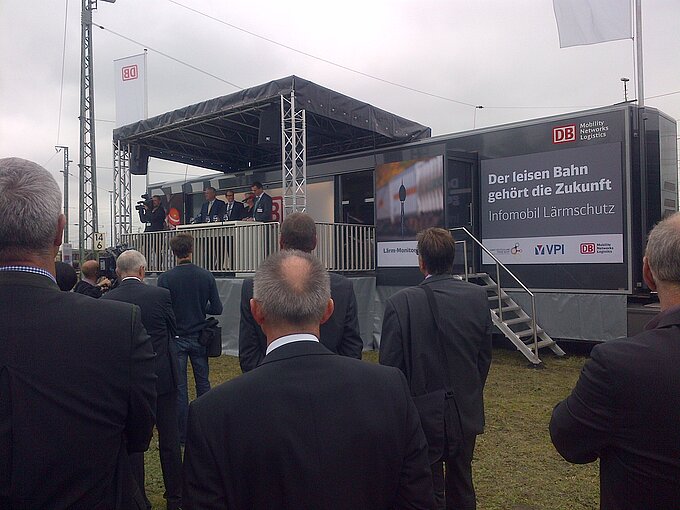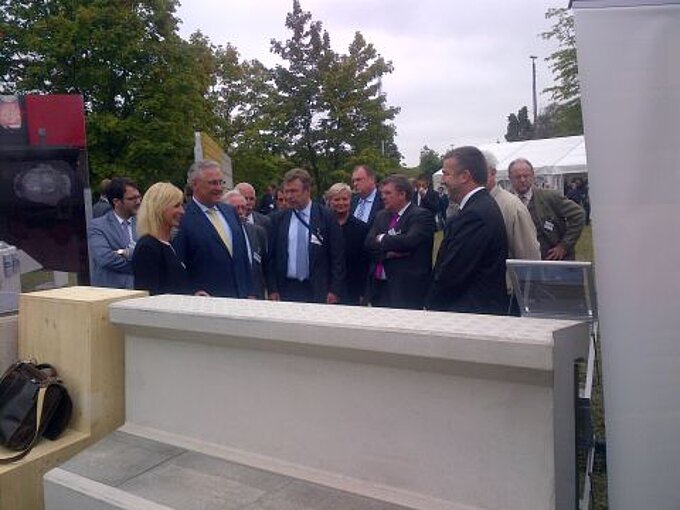
The theme of noise abatement becomes more and more important, so renowned companies presented their developments in this area. Of course, Hering participated in the noise abatement day of Deutsche Bahn in Munich on 15 September. Jürgen Kohlhas and Stefan Batz explained the effectiveness of gabion, ZBloc and a low wooden element applied next to the track. The exhibits were specially transported to Bavaria to be placed there on the Munich marshalling yard in the frame of the event. The event attracted the attention of TV and press.
Here is a detailed press release of Deutsche Bahn:
”The railway company demonstrates the efficacy of noise abatement measures at freight traffic lines” Noise abatement day Bavaria with Federal Minister of Transport Dobrindt, minister of state Joachim Herrmann, and DB Chief Technology Officer Dr. Heike Hanagarth - demonstration ride of a goods train with both conventional and new composite material brake pads. (Munich, 15 September 2014)
In the presence of Federal Minister of Transport Dobrindt, the Bavarian minister of transport Joachim Herrmann, and DB Chief Technology and Environment Officer Dr. Heike Hanagarth, Deutsche Bahn informed numerous deputies, heads of the district authorities, mayors and representatives of citizens’ groups on possible applications and the efficacy of noise abatement measures at high-traffic railway lines.
Special subject of the event on the marshalling yard München Nord was the reduction of rail noise produced by goods trains. The main element was a demonstration ride of a goods train whose front waggons were equipped with conventional shoe brakes and the rear ones with modern so-called “whispering brakes”. During this demonstration, the visitors could make sure of the new braking technology’s significant noise reduction. The combined application of the “whispering brake” and rail maintenance measures reduces the noise by 10 decibels. The human ear perceives this as a reduction by one half. Aside from this, the railway company presents noise abatement elements of various types such as rail dampers and gabion walls. At the “infomobil noise abatement”, the participants could catch up on the noise abatement elements in detail. In addition, various scenarios of passing goods and passenger trains were simulated in sound and image.
In its group strategy DB2020, Deutsche Bahn has voluntarily committed itself to ambitious goals in reducing rail noise in goods traffic. “By 2020, we want to reduce rail noise in goods traffic by one half compared with the year 2000. Until then, we will have retrofitted to whispering brakes all of our 60,000 waggons,” DB Chief Technology and Environment Officer Dr. Heike Hanagarth explained. Federal Minister of Transport Dobrindt pointed out: “We want to move more goods from road to rail. For that reason we have started a modernisation offensive: The resources for noise abatement have been increased by 30% to 130 million euro this year. Technical innovations to reduce noise are funded with 40 million euro. We will halve the trains’ noise by modernising the waggon fleet. We will support retrofitting by 2020 - those who will not have retrofitted to noise reducing technology by then will no longer be allowed to use the German network.“ Bavaria’s minister of transport stated: “Traffic noise is an item that motivates the citizens very much. Above all along the existing lines with heavy goods traffic there is a considerable backlog in terms of noise abatement. I therefore call upon the federal government to make available sufficient funds for noise redemption.“
Concerning the goods trains, the Bavarian minister of state said: “More quiet vehicles take a key role in noise reduction, since noise that is not produced, needs not to be fought in a costly way. That is why the self-commitment of DB to retrofit their waggons by 2020 deserves much appreciation. Concerning the vehicles we need a greater awareness above all across Europe, since less and less trains stop at the borders. That is why I am asking the federal government to continue its efforts in terms of quieter vehicles on the European floor.“ Aside from the 60,000 waggons of the DB daughter Schenker-Rail, about 120,000 other waggons run on German rails. They belong to other domestic and foreign railway companies and car owners. With the noise-based infrastructure charge (LaTPS), DB Netz AG has created an incentive for the use of quieter goods trains. In Germany, an extra charge is imposed on loud trains; these extra revenues are applied to reward the use of quieter retrofitted cars.
Editor: DB Mobility Logistics AG, Head of Communications Oliver Schumacher